Defined Jawline — facial contour protocol for men and women
Jawline definition is a structural outcome — the product of precise placement across muscle, bone, and soft tissue layers. The Defined Jawline protocol addresses each layer according to the individual anatomy, not a single technique applied uniformly.
Book ConsultationWhat the Defined Jawline protocol addresses and how it works
The Defined Jawline protocol delivers lower-face structural redefinition through a layered, anatomy-first approach — not a single filler session, but a coordinated plan across muscle, dermis, subcutaneous, and periosteal planes. The result is a jawline that reads as refined and inherent, not as a cosmetic intervention.
The lower face ages through four concurrent mechanisms: bone resorption at the mandibular angle and chin reduces the skeletal scaffold; fat compartment descent creates jowling and blurs the mandibular border; masseteric hypertrophy — accelerated by bruxism, stress, or constitutional anatomy — widens and squares the lower face asymmetrically; and dermal thinning reduces the skin's capacity to reflect light crisply along the jaw edge.
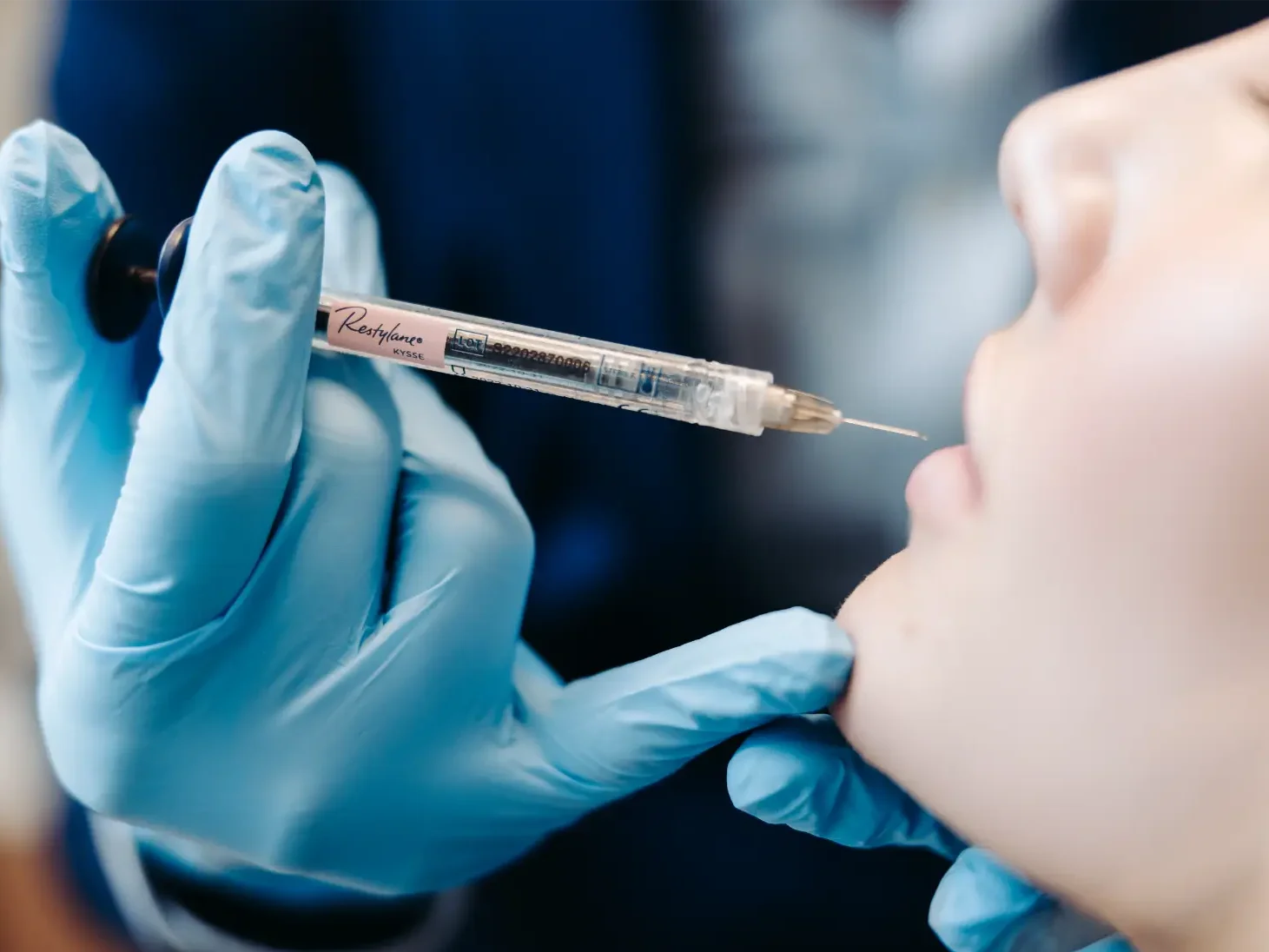
The protocol addresses each in sequence. Botulinum toxin (50–70 units per masseter, standard doses) reduces masseteric bulk over 4–6 weeks, narrowing the lower face and revealing the underlying skeletal contour (Ahn et al., Aesthetic Surgery Journal, 2021). High-G-prime hyaluronic acid filler placed at the mandibular angle and chin restores periosteal projection and recreates the sharp inferior border of the mandible. In patients with significant collagen depletion — typically those above 45 — calcium hydroxylapatite biostimulator (Radiesse or HarmonyCa) is layered into the submalar and pre-jowl zones to restore dermal scaffolding through progressive collagen I and III induction.
The sequencing matters as much as the product selection. Neuromodulator is placed first; filler follows once the muscular envelope begins to relax (typically at the same appointment if the protocol is well-mapped, or at a 4-week interval if the degree of masseteric hypertrophy is severe). Biostimulator, when indicated, is placed in the same session as filler or scheduled separately depending on volume of product required.
Clinical indications and contraindications for lower-face contouring
The Defined Jawline protocol is appropriate for a specific anatomical and clinical profile. Broad candidacy without individual assessment is not the standard here — the lower face is a structurally complex zone where ill-placed filler or incorrect product selection produces visible asymmetry or vascular compromise.
Candidates typically present with one or more of the following:
- Reduced mandibular angle definition with early jowl formation (common from age 40 onward)
- Masseteric hypertrophy causing facial widening or bruxism-related discomfort
- Chin under-projection or horizontal recession affecting profile balance
- Skin laxity along the inferior mandibular border without ptosis severe enough to require surgical correction
- Patients seeking facial slimming without lipolysis or surgery
- Men seeking angular, structured lower-face definition; women seeking refined contour without masculinisation
Absolute and relative contraindications:
- Active infection, abscess, or cutaneous lesion in the treatment area — treat before proceeding
- Prior placement of PMMA, liquid silicone, biopolymers, or non-resorbable fillers in the lower face — these contraindicate resorbable filler addition in most cases and require specialist assessment
- Autoimmune disease in active phase
- Pregnancy and lactation
- Known allergy to hyaluronic acid, lidocaine, or calcium hydroxylapatite components
- Mandibular implants or prior orthognathic surgery — anatomy is altered; protocol requires pre-treatment imaging review
- Severe skin ptosis or jowl descent requiring surgical correction — non-surgical protocol will under-deliver; referral to plastic surgeon is the appropriate step
- Biostimulator placement within 6 months of planned facial plastic surgery — risk of fibrosis interfering with surgical dissection planes
The clinical assessment maps bone, muscle, and soft tissue before any product is selected. Patients presenting with an expectation of surgical outcomes from non-surgical means are counselled accordingly at consultation.
Recovery, longevity, and how the Defined Jawline compares to surgical alternatives
The post-treatment course for the Defined Jawline protocol is typically mild. Filler placement along the mandibular border and chin may produce localised oedema for 48–72 hours and occasional bruising, both resolving without intervention. Botulinum toxin injection into the masseter carries minimal downtime — patients return to professional and social activities the same day. Biostimulator, when added, may produce a slightly longer oedema phase (3–5 days) due to higher product viscosity.
Expected timeline:
- Days 1–3: mild swelling, possible ecchymosis at filler entry points
- Days 7–14: filler integrates; asymmetry from differential oedema resolves
- Weeks 4–6: masseter volume reduction becomes clinically apparent; lower face narrows
- Months 3–6: biostimulator-driven collagen remodelling produces progressive skin quality improvement along the jaw
- Months 12–18: maintenance assessment; in most patients, a partial top-up at this interval sustains the result
The question of whether non-surgical jawline definition can replace surgery depends entirely on the degree of anatomical change required. For patients with moderate bone resorption, masseteric hypertrophy, and early jowling, the non-surgical protocol delivers results that are clinically meaningful and socially undetectable — which is the precise goal. For patients with significant soft tissue ptosis, excess skin, or skeletal deficiency beyond what a filler can scaffold, the honest recommendation is surgical consultation. The protocol does not compete with surgery; it occupies a different anatomical stratum.
A prospective cohort study by Bass and de la Cruz (Plastic and Reconstructive Surgery Global Open, 2020) documented significant patient satisfaction with combined neuromodulator and filler lower-face protocols at 12 months, with results rated as natural by blinded clinical assessors. Duration of effect and maintenance interval in clinical practice align with that data.
Dr. Thiago Perfeito
CRM-DF 23199 · Aesthetic and Regenerative Medicine
Physician with more than 10 years of practice in aesthetic and regenerative medicine. Master's degree in Aesthetic Medicine (2024). International training at Harvard Medical School and Mayo Clinic. Member of ASLMS, A4M, AMS, and NYAS. Practicing in Brasília, Lago Sul.
Learn about Dr. Thiago →Frequently asked questions about Defined Jawline
-
What does Defined Jawline include?
The protocol combines three categories of treatment mapped to individual anatomy: botulinum toxin to the masseter muscles (for volumetric reduction and slimming), hyaluronic acid filler placed at the mandibular angle and chin (for structural projection and border definition), and calcium hydroxylapatite biostimulator in select cases where dermal scaffolding is required. Not every patient requires all three components — the clinical assessment defines the sequence and product selection specific to each anatomy.
-
Is it different for men and women?
Yes, meaningfully so. Male lower-face anatomy is typically more angular, with a wider mandibular angle and greater masseter mass. For male patients, the protocol emphasises structural reinforcement and angular definition — larger filler volumes at the angle, stronger neuromodulator doses for masseteric reduction. For female patients, the goal is refined contour without masculinisation: finer projection at the chin, subtle mandibular border restoration, and jawline slimming through masseter treatment. The same products are used; the placement vectors, volumes, and endpoints differ considerably.
-
How long do results last?
In clinical practice, most patients maintain meaningful results for 12–18 months. Filler longevity at the mandibular angle is typically longer than at more dynamic sites (lips, periocular) because the area has lower mechanical movement. Masseter neuromodulator requires retreatment every 4–6 months in the first year; after two to three treatment cycles, the muscle often responds to longer intervals. Biostimulator-driven collagen induction is progressive and may extend the overall protocol result to 18–24 months in patients with good dermal response.
-
Can it replace surgery?
For patients with moderate anatomical change — bone resorption, masseteric hypertrophy, early jowl formation, and reasonable skin quality — the non-surgical protocol delivers clinically significant and socially undetectable results. It does not replicate the structural correction of a rhytidectomy. Patients with pronounced soft tissue ptosis, excess skin laxity, or skeletal deficiency beyond what a resorbable filler can scaffold are counselled towards surgical assessment at consultation. The protocol is not positioned as a surgical substitute — it occupies a distinct anatomical and clinical indication.
-
Recovery and side effects?
Recovery is typically mild. Filler placement may produce localised swelling and occasional bruising for 48–72 hours. Masseter injections carry minimal downtime — most patients resume professional activities the same day. Biostimulator, when used, may extend mild oedema to 3–5 days due to product viscosity. Serious adverse events (vascular occlusion, infection, inflammatory granuloma) are rare with proper technique and product selection; they are discussed at the clinical consultation and form part of the informed consent process.
Assess your jawline contour in Brasília
Individualised clinical evaluation of lower-face anatomy before any product is selected. Personalised protocol, not a standard treatment menu.