Hybrid Face Lift in Brasília — non-surgical signature protocol
A sequenced combination of fat grafting, biostimulation, and skin-remodelling technology delivers structural rejuvenation without a scalpel — the outcome reads as rested and refined, not treated.
Book ConsultationWhat the Hybrid Face Lift is — and why combination beats any single modality
The Hybrid Face Lift is a structured multi-modal protocol that addresses facial ageing across all four anatomical layers simultaneously — skin quality, subcutaneous volume, ligamentous support, and bony architecture — without requiring surgical access. No single injectable or device achieves this range; the protocol's effectiveness derives from the deliberate sequencing of complementary mechanisms.
Facial ageing is not a single-variable problem. Systematic imaging studies — including the work of Lambros (Plastic and Reconstructive Surgery, 2007) and subsequent volumetric CT analyses — demonstrated that the face loses fat compartments asymmetrically, bony resorption accelerates after the fifth decade, and skin loses structural collagen at roughly 1% per year from the age of 25 (Varani et al., J Invest Dermatol, 2006). A treatment that only tightens surface skin without restoring volume produces the characteristic "pulled" appearance of older surgical approaches. A treatment that only adds volume without improving skin quality leaves texture and luminosity unaddressed.
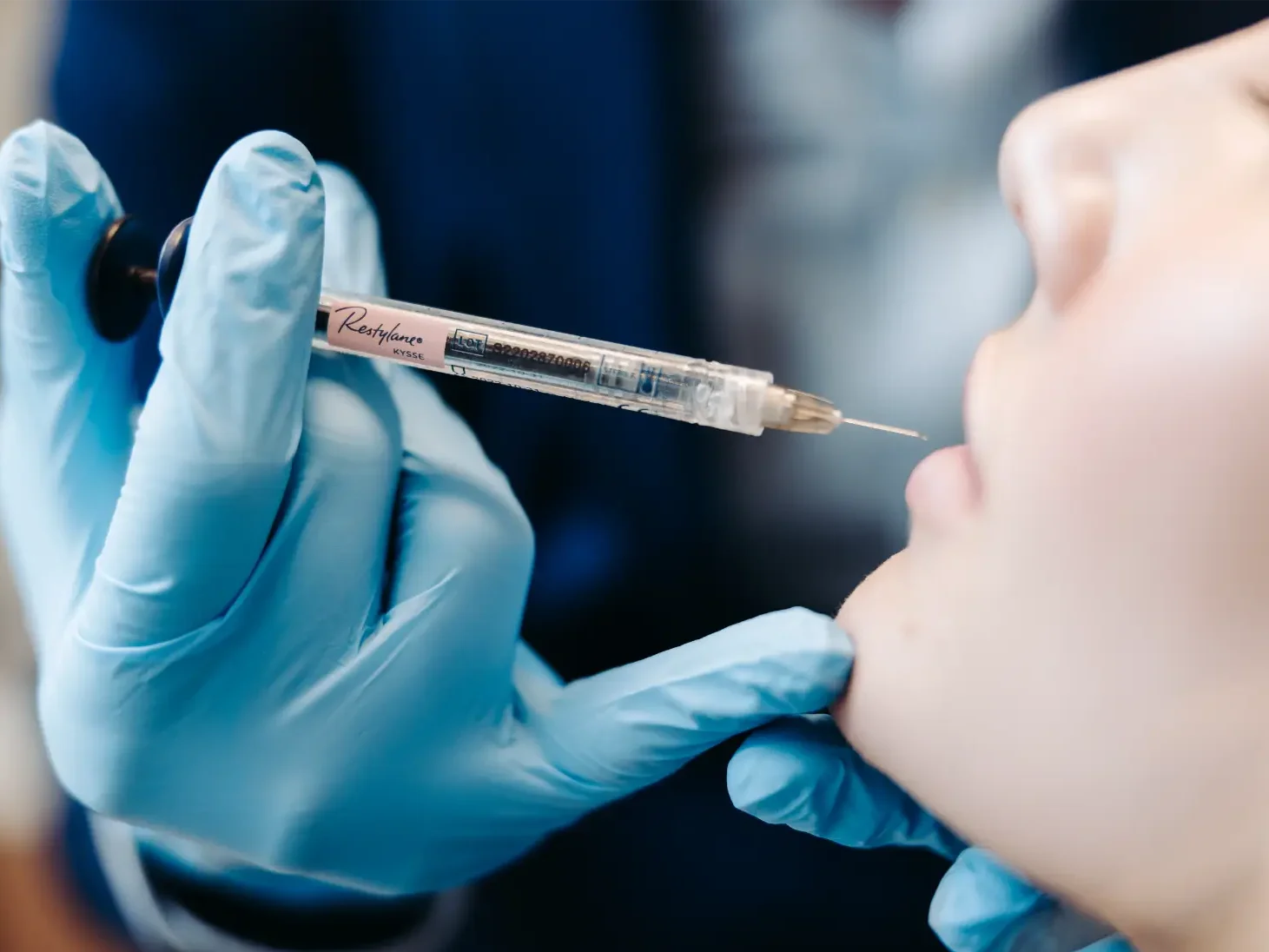
The Hybrid Face Lift integrates three functional tiers. The first tier — autologous fat grafting in micro-fat and nano-fat fractions — restores volumetric scaffolding in the deep and superficial fat compartments while delivering regenerative stromal-vascular fraction cells to the dermis (Tonnard et al., Aesthet Surg J, 2013). The second tier — poly-L-lactic acid (Sculptra) or calcium hydroxylapatite (Radiesse, HarmonyCa) — induces sustained collagen neogenesis in the reticular dermis over 3–6 months, prolonging and amplifying the volumetric result. The third tier — radiofrequency microneedling (Morpheus8) or fractional CO₂/Er:YAG laser (Fotona) — remodels the extracellular matrix, improves surface texture, and tightens the superficial musculo-aponeurotic system (SMAS) region from below the dermis.
Sequencing matters. Fat grafting is performed first, as subsequent energy delivery can accelerate graft resorption if applied too early. Biostimulators are introduced at 4–6 weeks post-grafting. Energy-based devices follow at 6–8 weeks, once initial graft integration is confirmed. The interval is not arbitrary — it mirrors the fibroblast activation windows described in the regenerative aesthetics literature.
Ideal candidates and clinical contraindications
The protocol is designed for adults — predominantly women aged 45–65 — presenting with the overlapping triad of volume deflation, skin laxity, and surface deterioration. Patients who respond best share several characteristics: moderate rather than severe ptosis, intact facial musculoskeletal architecture, realistic expectations regarding the distinction between surgical and non-surgical outcomes, and the time and willingness to engage with a multi-session protocol over 3–6 months.
Typical indications:
- Mid-face volumetric loss with flattening of the malar eminence and deepening of the nasolabial fold
- Jowling at the mandibular border with early loss of jawline definition
- Neck skin laxity and platysmal banding without significant submental adiposity
- Periorbital hollowing (tear trough, lid-cheek junction)
- Generalised surface-quality deterioration: fine lines, skin thinning, loss of luminosity
- Post-weight-loss facial deflation, including patients stabilised following GLP-1 receptor agonist therapy ("Ozempic face" phenotype)
Relative and absolute contraindications:
- Active cutaneous infection or inflammatory dermatosis in the treatment zone
- Autoimmune connective tissue disease in active phase
- Known hypersensitivity to any protocol component
- Anticoagulation therapy that cannot be safely bridged for the fat-grafting component
- Prior permanent fillers (PMMA, liquid silicone, polyacrylamide gel) in the planned injection planes — these represent an absolute contraindication to additional volume procedures in the affected areas
- Planned facial surgery within 6 months — biostimulators in particular are contraindicated in the 6 months preceding elective facial surgery owing to the risk of fibrosis interfering with surgical dissection planes (a concern documented in current ASPS guidance)
- Severe facial ptosis or significant excess skin — in these cases, surgical evaluation should precede or accompany any non-surgical planning
The clinical assessment determines feasibility, sequencing, and whether any single component of the protocol should be omitted or deferred for an individual patient.
Recovery, timeline, and realistic expectations versus surgery
Because the protocol is delivered in phases, there is no single recovery arc. Each component carries its own post-procedure window.
Fat grafting (where included) produces the most significant early post-procedure changes: swelling and bruising over 7–14 days, with final graft take assessed at 3 months. Patients are advised to avoid significant pressure on the treated areas and to protect from direct sun exposure during this period. Social downtime is generally 7–10 days for the fat-grafting session.
Biostimulator sessions produce mild localised swelling and occasional bruising for 3–5 days. Massage is contraindicated for the first 24 hours but may be recommended thereafter depending on the product used. The visible result builds over 6–12 weeks as collagen deposition progresses.
Energy-based device sessions (radiofrequency microneedling or fractional laser) produce erythema and superficial micro-crusting for 3–7 days. Sun protection factor 50+ is mandatory for a minimum of 4 weeks post-treatment. The skin-quality improvement continues for up to 6 months as dermal remodelling completes.
Comparison with surgical face lift: a surgical rhytidectomy addresses skin and SMAS in a single operative session with more immediate and dramatic correction of ptosis. Its primary limitations are general or deep sedation anaesthesia, 2–4 weeks of visible recovery, and the specific risks of haematoma, nerve paresis, and scarring. The Hybrid Face Lift does not replicate the tightening capacity of surgical undermining and SMAS plication for advanced ptosis. What it offers is multi-layer biological regeneration — fat, collagen, and dermal matrix — with a recovery profile distributed across shorter individual sessions rather than concentrated into one surgical episode. For the correct candidate, the functional and aesthetic result is clinically meaningful and not recognisable as a procedure. For a patient with significant excess skin or severe ptosis, surgery remains the more appropriate primary intervention.
Most patients undergoing the full protocol describe the result at 6 months as a version of themselves that appears rested and structurally coherent — the most consistent feedback is that colleagues and acquaintances comment on their appearance without identifying a specific change.
Dr. Thiago Perfeito
CRM-DF 23199 · Aesthetic and Regenerative Medicine
Physician with more than 10 years of practice in aesthetic and regenerative medicine. Master's degree in Aesthetic Medicine (2024). International training at Harvard Medical School and Mayo Clinic. Member of ASLMS, A4M, AMS, and NYAS. Practicing in Brasília, Lago Sul.
Learn about Dr. Thiago →Frequently asked questions about Hybrid Face Lift
-
What is the Hybrid Face Lift?
The Hybrid Face Lift is a non-surgical protocol that combines autologous fat grafting, collagen-stimulating biostimulators (Sculptra or Radiesse), and energy-based skin remodelling (radiofrequency microneedling or fractional laser) in a defined sequence. Each component targets a different layer of facial ageing — volume, dermal collagen, and surface quality — producing a cumulative result that no single modality achieves in isolation. The full protocol is delivered across 2–3 sessions over approximately 6–8 weeks.
-
Who is a candidate for non-surgical lifting?
Ideal candidates are adults — most commonly women aged 45–65 — presenting with moderate volume deflation, early-to-moderate skin laxity, and surface deterioration across the mid-face, jawline, and neck. The protocol is particularly well-suited to patients who have experienced accelerated facial deflation following significant weight loss. Patients with severe skin ptosis, prior permanent fillers in the planned treatment zone, or planned facial surgery within 6 months are not appropriate candidates and will be directed accordingly at clinical assessment.
-
How long do results last?
Results from the full protocol typically last 18–36 months, varying according to the components used, the extent of fat grafting, individual biology, and lifestyle factors including sun exposure and weight stability. The fat-grafting component provides the most durable volumetric change, as successfully engrafted fat cells behave as autologous tissue. Biostimulator effects persist for 18–24 months. Maintenance sessions — typically a single biostimulator or energy-device session — extend longevity significantly and are planned at the 12–18 month mark in most cases.
-
What is the recovery time?
Recovery is distributed across individual sessions rather than concentrated into one surgical episode. The fat-grafting session carries the longest recovery window: 7–14 days of swelling and bruising, with full social presentability typically at 10–14 days. Biostimulator sessions require 3–5 days for localised swelling to resolve. Energy-based device sessions produce erythema and surface micro-crusting for 3–7 days. Patients should plan for a total of 3–4 restricted social periods of under 2 weeks each, spread across the 6–8 week protocol delivery window.
-
How does it compare to a surgical face lift?
A surgical rhytidectomy provides a more immediate and anatomically definitive correction of facial ptosis, particularly for patients with significant skin excess, through undermining and SMAS plication. Its trade-offs include general or deep sedation anaesthesia, 2–4 weeks of visible surgical recovery, and the specific risks of haematoma, facial nerve paresis, and visible scarring. The Hybrid Face Lift offers multi-layer biological regeneration with distributed recovery and no general anaesthesia, but does not replicate the tightening capacity of surgery for advanced ptosis. For the correctly selected patient — moderate laxity, volume deflation, and surface deterioration — the non-surgical protocol delivers clinically meaningful and undetectable results. For severe ptosis or significant excess skin, surgical evaluation is the appropriate first step.
Discuss the Hybrid Face Lift with Dr. Thiago Perfeito
Clinical assessment in Brasília to determine candidacy, protocol sequencing, and realistic expectations. Appointments available in English.