Sculptra, Radiesse or HarmonyCa: which collagen biostimulator is best?
Three distinct injectable classes — PLLA, CaHA, and a CaHA–HA hybrid — each stimulate collagen by a different biological mechanism. Understanding the difference is the prerequisite for choosing the right one.
Book ConsultationHow each biostimulator works: the molecular basis
Sculptra (poly-L-lactic acid, PLLA), Radiesse (calcium hydroxyapatite, CaHA) and HarmonyCa (CaHA combined with cross-linked hyaluronic acid in a single syringe) are three distinct injectables that share one mechanism in common — they stimulate the body's own fibroblasts to produce new collagen — but they do so through different molecular pathways, at different rates, and with different immediate clinical effects. Choosing between them is a clinical decision, not a brand preference.
Sculptra contains PLLA microparticles suspended in water for reconstitution. Once injected, the particles are absorbed over weeks, triggering a foreign-body fibroblast response that drives sustained neocollagenesis. There is no immediate volumetric correction — the product is essentially invisible at the end of the session. The result builds progressively over three to six months, making Sculptra the biostimulator of choice when the objective is global collagen replenishment without an acute volume change. A standard protocol involves two to three sessions spaced four to six weeks apart.
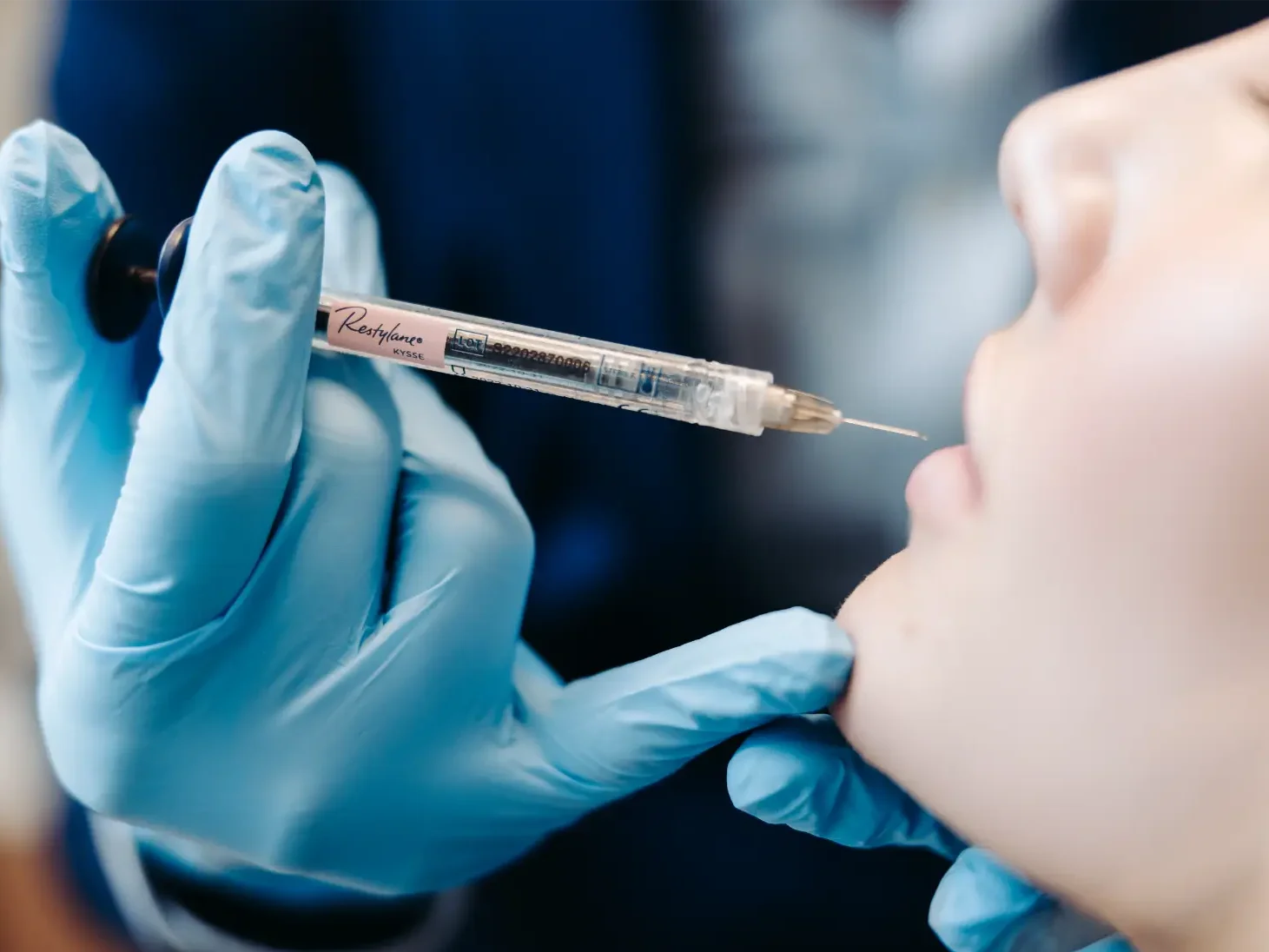
Radiesse consists of CaHA microspheres (approximately 30%) suspended in a carboxymethylcellulose gel carrier (approximately 70%). The gel provides immediate volume; the CaHA microspheres act as a physical scaffold around which fibroblasts organise and deposit new collagen. As the carrier gel reabsorbs over weeks, the collagen matrix takes over, sustaining the structural result. Radiesse can also be injected in a highly diluted form — the hyperdiluted technique — to treat skin laxity and skin-quality decline across larger areas such as the neck, décolletage or hands without adding bulk.
HarmonyCa (Allergan Aesthetics/AbbVie) is a hybrid: CaHA microspheres are pre-combined with cross-linked hyaluronic acid in a single prefilled syringe. The HA component delivers instant lift and hydration; the CaHA drives progressive collagen stimulation. The hybrid design eliminates the need to layer two separate products and reduces overall treatment time, making it particularly practical for patients requiring both immediate correction and long-term biostimulation.
Matching the right agent to indication, age and anatomy
The clinical decision rests on four variables: whether the patient needs immediate volume, the distribution and depth of tissue loss, the treatment timeline, and the presence of any contraindications. No single agent is universally superior — each has a defined role in the treatment hierarchy.
Sculptra (PLLA) — best suited for:
- Diffuse facial ageing with global collagen depletion rather than focal volume loss — typically patients in their mid-forties and beyond
- Patients who prefer a gradual, natural-appearing change and can commit to a multi-session protocol over two to three months
- Full-face or large-area treatment where adding discrete boluses of volume is not the primary goal
- Combination protocols where Sculptra addresses the dermal matrix while other agents correct specific anatomical landmarks
Radiesse (CaHA) — best suited for:
- Mid-face and cheek volume restoration requiring an immediate result with sustained collagen remodelling
- Patients who want outcome visible on the day of treatment
- Skin-quality and skin-laxity concerns in extra-facial areas (neck, hands, décolletage) via the hyperdiluted technique
- Patients who prefer a single-session protocol when the anatomy allows
HarmonyCa (CaHA + HA hybrid) — best suited for:
- Patients requiring both immediate volumisation and progressive biostimulation in the same appointment
- Mid-face, cheeks and temporal regions where dual-action correction is clinically indicated
- Patients seeking to reduce the number of separate injection sessions whilst achieving layered results
Contraindications common to all three:
- Active skin infection or inflammation at the injection site
- Known hypersensitivity to any product component
- Pregnancy and breastfeeding
- Autoimmune conditions or immunosuppressive therapy — clinical assessment required
- Planned facial surgery within six months: biostimulators are not indicated in the pre-operative period, as the fibrous tissue response may interfere with surgical dissection planes and wound healing. Post-surgical use, by contrast, is well-established in plastic surgery practice.
In aesthetic medicine practice, biostimulators are frequently combined with each other and with other modalities — radiofrequency, focused ultrasound, toxin — in protocols designed for the specific ageing pattern of each patient.
Sculptra or HarmonyCa, Radiesse or HarmonyCa: the pairwise decision
There are three pairs to compare — Sculptra or HarmonyCa, Radiesse or HarmonyCa, Sculptra or Radiesse — and each pair collapses into a single clinical question. The answer is the indication, never the brand.
Sculptra or HarmonyCa. The dividing line is day-one volume. Sculptra (PLLA, Galderma) adds none: the product is essentially invisible at the end of the session, and the change arrives as new collagen across two to three sessions over three to six months. HarmonyCa (CaHA microspheres in cross-linked hyaluronic acid with lidocaine, Allergan Aesthetics/AbbVie) corrects on the day of treatment through its HA component and continues to stimulate collagen through the CaHA. Diffuse collagen depletion with no deadline favours Sculptra; a defined structural deficit that has to read immediately favours HarmonyCa. The two can also be sequenced across a treatment plan rather than set against each other. HarmonyCa vs Sculptra, in detail.
Radiesse or HarmonyCa. Both give an immediate result, so volume is not the discriminator here — the carrier is. Radiesse (CaHA microspheres in a carboxymethylcellulose gel, Merz Aesthetics) delivers its initial correction through a gel that reabsorbs over weeks, handing the result over to the collagen matrix that formed around the microspheres. HarmonyCa delivers it through cross-linked hyaluronic acid, which persists on its own terms alongside the CaHA. Radiesse is also the agent with an established hyperdiluted use for skin quality over larger areas, which the single prefilled HarmonyCa syringe does not replicate. HarmonyCa vs Radiesse, in detail.
HarmonyCa filler vs Sculptra, HarmonyCa filler vs Radiesse. Phrased that way, the question is a real one. HarmonyCa is classified as a hybrid — filler and biostimulator in the same syringe — whereas Sculptra is a biostimulator with no filling action at all, and Radiesse is a biostimulator whose gel carrier fills only temporarily. Calling HarmonyCa a filler is accurate but incomplete: comparing it with the other two on filling capacity alone answers half the question and leaves out the collagen behaviour that determines what the face looks like at six months. The brand is also written Harmony Ca and Harmonica; all three spellings refer to the same CaHA + HA hybrid.
What decides each pair, and where the full comparison sits:
| Comparison | The decisive variable | Full comparison |
|---|---|---|
| Sculptra or HarmonyCa | Whether the correction has to be visible on the day of treatment | HarmonyCa vs Sculptra |
| Radiesse or HarmonyCa | The carrier — a gel that reabsorbs, or cross-linked hyaluronic acid that does not | HarmonyCa vs Radiesse |
| Sculptra or Radiesse | Gradual neocollagenesis with no added volume, against an immediate scaffold that then remodels | All three compared |
Commercial independence: Dr. Thiago Perfeito's practice holds no commercial relationship, sponsorship or consultancy contract with Galderma, Merz Aesthetics or Allergan Aesthetics/AbbVie. Every comparison on this page is organised by clinical indication, and no product is presented as best in general terms.
Sessions, duration and what to realistically expect
Understanding the timeline of each product is essential for setting expectations before the first appointment. The three agents have materially different kinetics.
Sculptra requires patience. The PLLA particles drive collagen synthesis over a period of months, meaning the patient leaves the clinic with little visible change. Results become perceptible at around six to eight weeks and continue to develop through the third and fourth months after the final session. A standard treatment involves two to three sessions, each separated by four to six weeks. Duration of effect is typically reported at two years or beyond, though individual variation is significant and depends on baseline collagen status, lifestyle and follow-up maintenance.
Radiesse produces a visible result on the treatment day through its gel carrier, which then reabsorbs over the following weeks as the CaHA scaffold matures and fibroblast-mediated collagen deposits consolidate. Most patients find that results at three to four months — when the gel is largely gone and the collagen matrix has formed — are actually more refined than the immediate post-treatment appearance. Duration is approximately twelve to eighteen months for facial applications.
HarmonyCa combines the kinetics of both components. The cross-linked HA provides correction visible from day one; the CaHA-driven collagen remodelling matures progressively over the following months. The dual mechanism means the result evolves rather than simply fading — many patients report that the outcome looks better at six months than at six weeks. Clinical experience suggests duration comparable to Radiesse for the collagen component, with the HA portion lasting according to the cross-linking density of the specific formulation.
For all three agents, ISAPS (International Society of Aesthetic Plastic Surgery) and leading academic aesthetic medicine societies consistently reinforce that combination protocols — matching the biostimulator to the patient's specific tissue deficit rather than using a single product for every indication — produce the most coherent long-term outcomes.
Regarding cost: biostimulators in Brasília fall in a similar investment bracket, typically in the range of R$ 2.900–3.900 per session for facial applications of Sculptra, Radiesse or HarmonyCa. The total investment depends on the number of sessions required, the volume used and whether the protocol combines multiple agents. A detailed treatment plan — including session count, intervals and product quantities — is established at consultation.
Dr. Thiago Perfeito
CRM-DF 23199 · Aesthetic and Regenerative Medicine
Physician with more than 10 years of practice in aesthetic and regenerative medicine. Master's degree in Aesthetic Medicine (2024). International training at Harvard Medical School and Mayo Clinic. Member of ASLMS, A4M, AMS, and NYAS. Practicing in Brasília, Lago Sul.
Learn about Dr. Thiago →Frequently asked questions about Collagen biostimulators
-
How does each biostimulator work?
Sculptra (PLLA) triggers a fibroblast response as its microparticles are absorbed, driving gradual neocollagenesis with no immediate volumetric correction. Radiesse (CaHA) provides an instant scaffold via its gel carrier plus progressive collagen stimulation as CaHA microspheres persist in tissue. HarmonyCa combines CaHA with cross-linked hyaluronic acid in a single prefilled syringe, delivering both immediate volume and sustained biostimulation. All three induce new collagen, but through distinct mechanisms, at different rates and with different day-one clinical results.
-
Which one suits which indication and age?
Sculptra suits patients with diffuse collagen depletion — typically from the mid-forties onward — who can commit to a multi-session protocol and prefer a gradual transformation. Radiesse suits patients requiring immediate mid-face volume with sustained remodelling, or skin-quality improvement across extra-facial areas via hyperdilution. HarmonyCa suits patients who need both instant correction and progressive biostimulation in fewer sessions. Age alone does not determine the choice — tissue quality, anatomical distribution of loss and treatment timeline are the decisive clinical variables.
-
How many sessions and how long do results last?
Sculptra typically requires two to three sessions separated by four to six weeks; results develop over three to six months and may persist for two years or longer. Radiesse is often administered in a single session with results lasting approximately twelve to eighteen months; the collagen component matures over three to four months. HarmonyCa can achieve meaningful correction in one session, with the HA providing immediate correction and the CaHA-driven collagen maturing over several months. All figures reflect population averages — individual duration depends on anatomy, metabolism and maintenance intervals.
-
What are the contraindications?
Common contraindications across all three products include active infection or inflammation at the site, hypersensitivity to any component, pregnancy and breastfeeding. Patients planning facial surgery within six months should defer biostimulator treatment: the fibrous tissue response may interfere with surgical dissection planes and wound healing. This is a specific pre-operative contraindication — post-surgical use is well-established. Autoimmune conditions and immunosuppressive therapy require individual clinical assessment. A full medical history is taken at consultation to identify any personal contraindications.
-
Are these brands FDA/EMA/ANVISA approved?
Sculptra and Radiesse have longstanding regulatory histories with the US FDA for aesthetic facial indications, and are registered for use in multiple jurisdictions including Brazil (ANVISA). HarmonyCa has received regulatory clearance in a number of markets; its specific approval status varies by country and should be confirmed at the time of treatment. Regulatory approval confirms the product's safety and efficacy profile for its stated indication — it does not supersede individual clinical assessment of whether a given product is appropriate for a specific patient.
-
Sculptra or HarmonyCa: which should I choose?
The question is decided by whether the correction has to be visible on the day of treatment. Sculptra adds no volume: the result is new collagen that appears over three to six months across two or three sessions, which suits diffuse collagen depletion with no deadline. HarmonyCa corrects immediately through its cross-linked hyaluronic acid component and keeps stimulating collagen through the CaHA, which suits a defined structural deficit that has to read straight away. Neither is superior in general terms, and the two can be sequenced within one treatment plan rather than chosen against each other.
-
Is HarmonyCa filler the same as Radiesse?
No. Both contain calcium hydroxyapatite microspheres, but the carrier differs and that changes the clinical behaviour. Radiesse suspends its CaHA in a carboxymethylcellulose gel that reabsorbs over weeks, leaving the collagen matrix to hold the result. HarmonyCa suspends its CaHA in cross-linked hyaluronic acid with lidocaine, in a single prefilled syringe, so the filling component persists alongside the biostimulation — which is why HarmonyCa is classified as a hybrid rather than a pure biostimulator. HarmonyCa is made by Allergan Aesthetics/AbbVie and Radiesse by Merz Aesthetics; the spellings Harmony Ca and Harmonica both refer to HarmonyCa.
Not sure which biostimulator suits your case?
Discuss your case with Dr. Thiago Perfeito. Personalised care in Brasília — INTI clinic, Lago Sul. CRM-DF 23199.