Best skin tightening treatment in Brasília: Ultraformer, Morpheus8 or biostimulators?
Three evidence-based technologies — focused ultrasound, radiofrequency microneedling and collagen biostimulators — address skin laxity through distinct mechanisms. Clinical selection depends on laxity grade, skin anatomy and patient goals.
Book ConsultationWhich technology addresses which degree of laxity?
The choice between Ultraformer MPT, Morpheus8 and collagen biostimulators is not a matter of preference — it follows the degree of laxity, the tissue plane requiring intervention, and whether volume loss is concurrent. No single device category covers all scenarios; in moderate and advanced presentations, combinations are standard practice rather than the exception.
Focused ultrasound — the technology platform behind the Ultraformer MPT used at the clinic — acts at defined tissue depths: 1.5 mm (superficial dermis), 3.0 mm (deep dermis) and 4.5 mm (SMAS level). At the SMAS, the mechanism approximates the tissue plane addressed in surgical lifting, producing a vector of contraction without incisions. This makes Ultraformer particularly suited to mild laxity in the lower face, jowl area and neck, and to brow elevation. Downtime is minimal: mild erythema lasting a few hours, with patients returning to normal activity the same day.
Radiofrequency microneedling (Morpheus8) combines mechanical micro-injury with deep bipolar radiofrequency delivery. Insulated needles deposit thermal energy into the deep reticular dermis and subdermis — the depth profile (up to 8 mm with the 40-pin tip) allows treatment of skin laxity concurrent with superficial adipose irregularity. This makes Morpheus8 particularly relevant for moderate laxity, perioral lines and neck texture where dermis-level remodelling is needed. Transient erythema and micro-crusting lasting two to five days are expected, and treated areas should be protected from sun exposure during recovery.
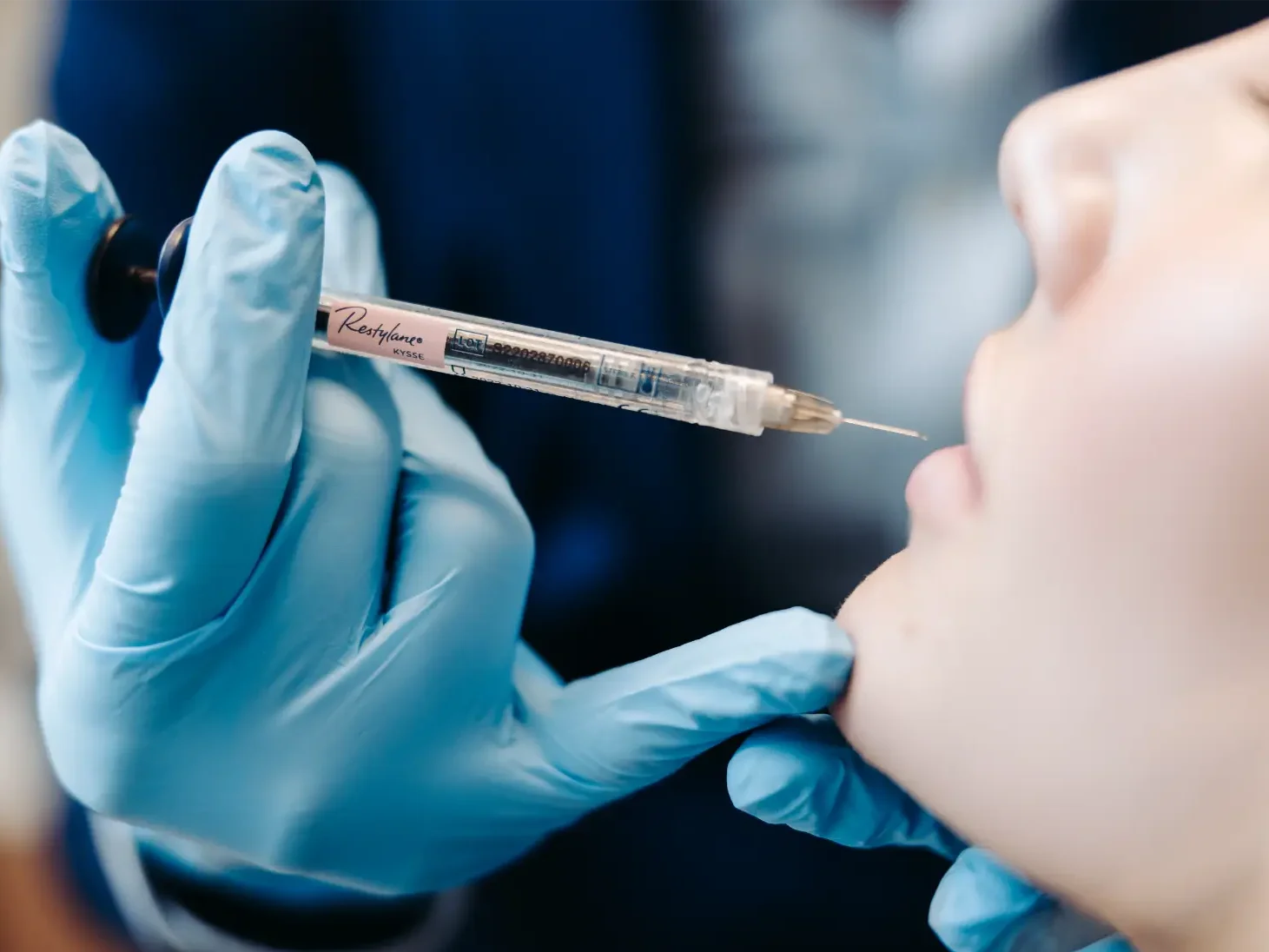
Collagen biostimulators (poly-L-lactic acid — Sculptra; calcium hydroxyapatite — Radiesse) address a separate variable: volumetric loss secondary to collagen depletion. In patients over 45, laxity is rarely isolated — it is compounded by dermal thinning and mid-face volume deflation. Injecting a biostimulator progressively restores dermal density, improving support for overlying structures. Peak effect at approximately six months; protocols typically require two to three sessions. Combining a biostimulator with focused ultrasound or RF microneedling — layering neocollagenesis with tissue contraction — is the approach most widely supported in current aesthetic medicine consensus.
Clinical criteria: who is a candidate for each modality
Selecting the appropriate technology requires assessment of laxity grade, skin thickness, tissue anatomy and concurrent volume loss. Patients attending the clinic with prior experience of premium centres in London, New York or Singapore will recognise this as the same decision framework applied internationally.
- Mild laxity (early jowling, brow ptosis, neck laxity grade I–II): focused ultrasound (Ultraformer MPT) as primary modality; optional combination with a biostimulator if dermal thinning is present. One to two sessions per year. Downtime negligible.
- Moderate laxity (established jowling, mid-face deflation, perioral lines, neck grade II–III): Morpheus8 as primary modality for dermal remodelling; biostimulator (Sculptra or Radiesse) for concurrent volumetric restoration; Ultraformer as adjunct for SMAS contraction. Two to three sessions of each modality spaced four to eight weeks apart.
- Advanced laxity with significant excess skin: non-surgical modalities produce measurable but limited improvement; surgical consultation (blepharoplasty, face lift, neck lift) should be discussed. Non-surgical protocols are relevant for peri-surgical optimisation or as bridge therapy.
- Post-weight-loss laxity (including GLP-1 agonist-related skin changes — "Ozempic face"): combined protocol addressing volume loss (biostimulator), dermal quality (RF microneedling) and tissue contraction (focused ultrasound); timing ideally three to six months after weight stabilisation.
- Preventive protocols (ages 35–45, early signs): focused ultrasound plus low-dose biostimulator for collagen maintenance; goal is delaying progression rather than correcting established laxity.
Contraindications to be reviewed at assessment: active skin infection over treatment area; implanted pacemakers or neurostimulators (absolute for RF devices); pregnancy or lactation; isotretinoin within six months (RF microneedling); unrealistic expectations regarding degree of correction achievable without surgery.
Biostimulator-specific note: collagen biostimulators (Sculptra, Radiesse) are not recommended in the six months preceding facial surgery. Their use in the post-surgical context, however, has a well-established history in plastic surgery practice — the timing restriction is specific to proximity to an elective surgical procedure, not to the combination itself. Patients planning surgery should disclose this during clinical assessment.
The combination principle and what to expect in Brasília
In international aesthetic medicine practice — reflected in consensus guidelines from ISAPS, IMCAS and ASDS — the single-modality approach to facial laxity has been progressively replaced by layered protocols. The biological rationale is straightforward: laxity results from concurrent loss of dermal collagen, subcutaneous volume and SMAS support. Addressing only one of these variables yields a partial result. A protocol that combines SMAS-level contraction (focused ultrasound), dermal remodelling (RF microneedling) and collagen restoration (biostimulator) works across all three planes simultaneously.
The sequence matters. At the clinic, the general approach for moderate laxity is: biostimulator first (to begin progressive neocollagenesis), followed by focused ultrasound or RF microneedling at four to six weeks (once the initial tissue response has stabilised). This sequence is adapted to individual anatomy and treatment goals — it is not a protocol applied uniformly.
Patients familiar with premium centres in major capitals will find the same device platforms and injectables available in Brasília. The Ultraformer MPT is a third-generation focused ultrasound system; Morpheus8 is the same InMode platform used at leading clinics in New York, London and Singapore; Sculptra (Galderma) and Radiesse (Merz Aesthetics) are the globally recognised biostimulator references. What the Brasília setting adds is a significantly different investment profile — non-surgical skin tightening protocols at internationally comparable quality are accessible at a fraction of the cost in major Western capitals.
For patients over 45 — the demographic for whom laxity management is most clinically relevant — the combination approach also addresses a biological reality: declining oestrogen accelerates collagen degradation (approximately 30% of dermal collagen lost in the first five years after menopause, according to published dermatological literature). A protocol that restores collagen density while contracting existing lax tissue is physiologically aligned with this mechanism.
Regarding investment: Morpheus8 sessions in Brasília range from R$ 6,000–9,000 per session for the face (R$ 9,500–15,000 for face and neck combined), and Fotona laser sessions (used in Fotona 4D protocols addressing laxity) range from R$ 4,500–5,500 per session. Biostimulators (Sculptra and Radiesse) are in the R$ 2,900–3,900 range per session. Focused ultrasound investment is best discussed at clinical assessment, as session count and cartridge combination vary materially by anatomy. Any quoted investment should include the full protocol — not a per-session figure that obscures the real treatment cost.
Dr. Thiago Perfeito
CRM-DF 23199 · Aesthetic and Regenerative Medicine
Physician with more than 10 years of practice in aesthetic and regenerative medicine. Master's degree in Aesthetic Medicine (2024). International training at Harvard Medical School and Mayo Clinic. Member of ASLMS, A4M, AMS, and NYAS. Practicing in Brasília, Lago Sul.
Learn about Dr. Thiago →Frequently asked questions about Skin tightening
-
Which technology works best for mild vs advanced laxity?
For mild laxity — early jowling, brow ptosis, neck grade I–II — focused ultrasound (Ultraformer MPT) acting at SMAS level is the primary non-surgical modality, often combined with a low-dose biostimulator if dermal thinning is present. For moderate laxity with established jowling and mid-face deflation, RF microneedling (Morpheus8) plus a biostimulator (Sculptra or Radiesse) plus focused ultrasound as adjunct is the standard combined approach. Advanced laxity with significant skin excess typically requires surgical assessment; non-surgical technologies can optimise skin quality but cannot compensate for excess skin volume.
-
How many sessions does each protocol need?
Focused ultrasound (Ultraformer MPT): typically one to two sessions per year, with measurable improvement developing over three to six months as collagen remodelling progresses. RF microneedling (Morpheus8): for moderate laxity, a series of two to three sessions at four- to six-week intervals is standard, followed by annual maintenance. Biostimulators (Sculptra, Radiesse): two to three sessions at four- to eight-week intervals for the induction protocol; annual or biannual maintenance thereafter. Combined protocols require clinical scheduling to sequence technologies appropriately — not all modalities are applied in the same session.
-
Is there downtime?
Focused ultrasound (Ultraformer MPT): minimal. Erythema and mild swelling lasting a few hours; most patients return to normal activity the same day. This is the modality of choice when downtime is a significant practical constraint. RF microneedling (Morpheus8): transient erythema, pin-point micro-crusting and mild swelling over two to five days; social downtime is present and should be planned for. Vigorous exercise and sun exposure should be avoided for 48–72 hours minimum. Biostimulators: mild injection-site swelling and occasional bruising resolving within a few days; no significant functional downtime.
-
Can technologies be combined with biostimulators?
Yes — combination is the standard approach in current clinical practice for moderate laxity. Focused ultrasound and RF microneedling address tissue contraction and dermal remodelling; biostimulators (Sculptra — poly-L-lactic acid; Radiesse — calcium hydroxyapatite) address concurrent volumetric loss and progressive collagen restoration. The two mechanisms are complementary and work across different tissue planes. Important timing note: biostimulators are not recommended in the six months before planned facial surgery, as the inflammatory remodelling process can interfere with surgical dissection. Patients with upcoming surgical plans should disclose this at clinical assessment.
-
What is the investment range in Brasília?
Investment varies materially by modality, session count and protocol scope. As reference: Morpheus8 sessions range from R$ 6,000–9,000 for the face and R$ 9,500–15,000 for face plus neck per session; Sculptra and Radiesse biostimulator sessions are in the R$ 2,900–3,900 range per session; Fotona 4D sessions addressing laxity are R$ 4,500–5,500 per session. Focused ultrasound investment depends on the cartridge combination and anatomy and is confirmed at assessment. A complete protocol involving multiple modalities should be costed as a full programme — per-session figures without context understate the actual investment required for a meaningful result.
Discuss your skin tightening protocol with Dr. Thiago Perfeito
Discuss your case with Dr. Thiago Perfeito. Personalised care in Brasília. CRM-DF 23199.