Which dermal filler brand is best? Juvéderm, Restylane and beyond
Choosing a filler is not a question of brand loyalty. It is a question of matching gel rheology to anatomical need — and the injector's command of that match determines the outcome far more than the label on the syringe.
Book ConsultationWhat actually separates one filler brand from another
No single dermal filler brand is universally best — what matters is the match between a product's physical properties and the anatomical problem it is being asked to solve. Hyaluronic acid (HA) is the shared molecule across the major commercial families — Juvéderm (Allergan/AbbVie), Restylane (Galderma), Belotero (Merz) and Teosyal (Teoxane). What differentiates them is not the molecule itself but how that molecule has been engineered: the degree of cross-linking, particle size, concentration and the resulting rheological profile.
Two parameters dominate the clinical decision. The first is elastic modulus (G’), a measure of the gel's firmness and capacity to resist deformation under tissue pressure. A high-G’ product lifts and projects — appropriate for cheek augmentation or jawline definition, where structural support is the objective. A low-G’ product integrates softly into tissue — appropriate for lips or fine perioral lines, where stiffness would produce an unnatural feel or visible nodules.
The second parameter is cohesivity: the degree to which the gel holds together rather than dispersing. Highly cohesive gels remain localised, which is advantageous in the lips and nasolabial region. Less cohesive products spread more evenly, which can be beneficial for superficial hydration or large-surface-area treatment.
Within the Juvéderm family, for instance, Voluma is engineered for deep structural volumisation (malar region, chin projection), while Volbella carries a lower G’ and cohesivity suited to lip augmentation and fine lines. Restylane Lyft and Restylane Defyne occupy a comparable functional position to Voluma and Volift respectively within the Galderma portfolio. Neither brand is inherently superior — both offer products calibrated to different depths and tissue types.
Belotero Balance occupies a distinctive niche: its IPN (Cohesive Polydensified Matrix) technology produces a highly integrative gel that is particularly well tolerated in the superficial dermis, where other products risk the Tyndall effect — a bluish discolouration visible through thin skin. Teosyal's RHA (Resilient Hyaluronic Acid) line uses a gentler cross-linking process intended to preserve HA chain length, producing gels that adapt to dynamic facial movement rather than resisting it.
Does the brand matter more than the injector?
The short answer is no — and any honest assessment of outcomes confirms it. The injector's anatomical knowledge, technical precision and product-to-indication matching account for a substantially greater proportion of the result than the commercial label. The same Juvéderm Voluma syringe produces a natural cheek lift in one pair of hands and an overfilled, displaced appearance in another. Brand choice without clinical rationale is not a strategy — it is marketing.
That said, brand and product selection remain clinically relevant because the physician must choose correctly within the range available. An injector who uses a single product for every region, regardless of rheological profile, is not compensating for brand with skill — they are compounding the limitation. The right question is not "which brand is best" but "which product, at which depth, in which plane, for this patient's anatomy today."
Key criteria for a clinically sound filler consultation:
- Product-to-region matching: lips require low G’, soft cohesive product; cheeks and jawline require high G’, projecting gel; periorbital region requires thin, highly integrative product to avoid Tyndall effect.
- Assessment of existing filler: prior treatments — especially if unknown — alter tissue architecture. Ultrasound-guided assessment or cautious injection plane selection is warranted.
- Genuine product only: sealed, batch-traceable, purchased through registered distributor. Products outside the regulated supply chain may be counterfeit, diluted or stored incorrectly.
- Hyaluronidase availability: any clinic performing HA injections must have hyaluronidase on site for vascular emergency management. This is non-negotiable.
- Conservative volume: the dose that achieves the clinical objective — not the maximum that can be justified. Overcorrection is the commonest error in the current aesthetic market.
- Contraindications respected: active skin infection at the injection site, known allergy to HA or lidocaine, history of severe anaphylaxis, and pregnancy are absolute contraindications across all brands. PMMA, liquid silicone and biopolymers in the face, lips or perioral region are contraindicated — their use is associated with chronic granuloma, migration and outcomes that are not correctable with hyaluronidase.
Institutional consensus from ISAPS, ASDS and IMCAS consistently reinforces that training, anatomy knowledge and product logic — not brand preference — define complication rates and aesthetic outcomes.
Choosing a filler in Brasília: what the consultation looks like
In a rigorous aesthetic medicine consultation, filler brand selection occurs at the end of the clinical reasoning process, not at the beginning. The physician assesses facial anatomy — volumes, proportions, skin quality, muscle dynamics, bone resorption pattern — and identifies the correction objective. The product is then selected to match that objective: its G’, cohesivity and placement depth must align with what the tissue needs in that specific region.
For diplomats and expatriates accustomed to practices in London, New York or Singapore, the clinical logic is identical — the major international brands (Juvéderm, Restylane, Belotero, Teosyal) are available in Brazil through authorised distributors. Confirming product authenticity during a consultation is straightforward: sealed packaging, intact batch code, verifiable manufacturer registration with ANVISA (Brazil's national regulatory agency). Any practitioner who cannot provide these assurances warrants concern.
Costs for HA filler in Brasília vary considerably by product, technique, number of syringes and anatomical complexity. As a general reference, single-syringe facial filler from the major families (Juvéderm, Restylane) ranges from R$ 1,900 to R$ 2,800 per syringe in Brasília. This reflects product cost, physician experience, clinical infrastructure and post-treatment follow-up — not just the volume of gel injected. Pricing significantly below this range in the current market typically signals diluted product, syringe-sharing between patients, or application by an inexperienced practitioner. None of these scenarios is acceptable in a region as anatomically sensitive as the face.
For patients considering a full facial assessment — combining lip augmentation, malar projection or jawline definition in a single session — a personalised treatment plan is far more useful than a catalogue of brand names. The plan will specify product family, estimated volume, injection plane and the sequencing of any combined modalities (toxin, biostimulator, energy-based device).
Duration ranges from roughly six to eighteen months depending on product density and site. Lips metabolise HA faster than cheeks or the mandibular border; highly dynamic regions generally require earlier retreatment than static areas.
Related reading:
Dr. Thiago Perfeito
CRM-DF 23199 · Aesthetic and Regenerative Medicine
Physician with more than 10 years of practice in aesthetic and regenerative medicine. Master's degree in Aesthetic Medicine (2024). International training at Harvard Medical School and Mayo Clinic. Member of ASLMS, A4M, AMS, and NYAS. Practicing in Brasília, Lago Sul.
Learn about Dr. Thiago →Frequently asked questions about Dermal fillers (hyaluronic acid)
-
What differs between major filler brands?
The molecule — hyaluronic acid — is shared across Juvéderm (Allergan/AbbVie), Restylane (Galderma), Belotero (Merz) and Teosyal (Teoxane). What differs is engineering: degree of cross-linking, concentration, particle size and resulting rheology. Elastic modulus (G’) determines firmness and lifting capacity; cohesivity determines whether the gel stays localised or integrates broadly. Each brand offers a range of products calibrated to different depths and regions. Within a brand family, the products are not interchangeable — a lip filler and a cheek filler from the same manufacturer have fundamentally different physical profiles.
-
Does the brand matter more than the injector?
No. Injector skill, anatomical knowledge and product-to-indication matching account for the majority of the aesthetic outcome — not the commercial label. The same syringe produces different results in different hands. That said, correct product selection within the available range is a clinical responsibility: using a high-G’ structural gel in the lips, for instance, produces firmness and potential nodularity regardless of injector technique. Brand and injector are both relevant; injector competence weighs more heavily.
-
Which brand for lips, cheeks, jawline?
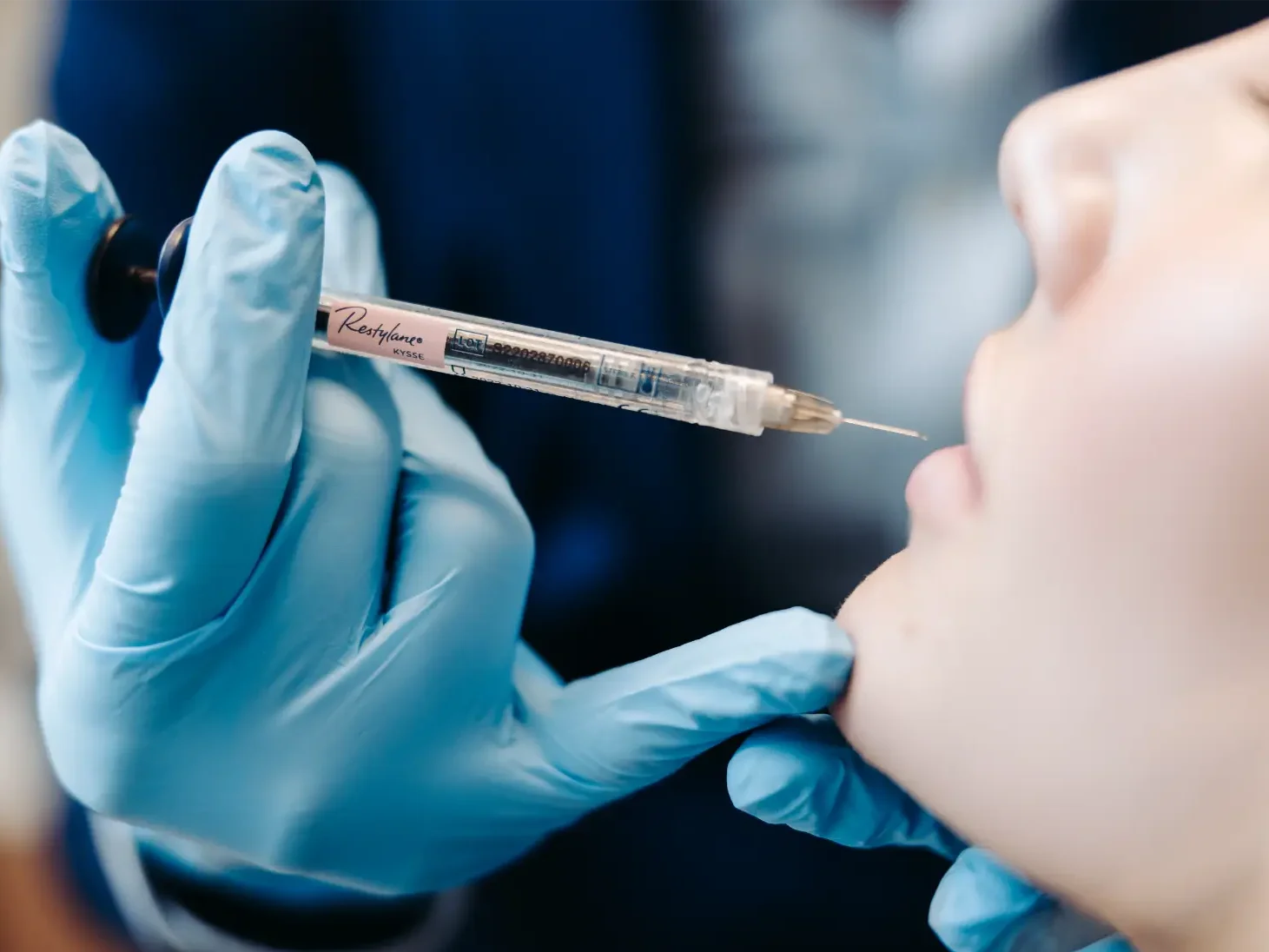
The answer is defined by rheology, not brand loyalty. For lips: a low-G’, soft, cohesive product is required — Juvéderm Volbella, Restylane Kysse or equivalent low-elasticity products from Belotero or Teosyal. For cheeks: a high-G’, projecting gel placed supraperiosteally — Juvéderm Voluma, Restylane Lyft or structural equivalents. For jawline definition: similarly high-G’, placed along the mandibular border. The specific product within a brand family matters more than the brand itself.
-
How do I verify a genuine product?
Genuine HA fillers arrive in sealed, intact packaging with a traceable batch code. In Brazil, products must be registered with ANVISA — the national health regulatory agency. Ask your physician to show you the syringe packaging before treatment begins. Products sourced outside the authorised distributor chain may be counterfeit, diluted or incorrectly stored, compromising both safety and result. If a clinic cannot provide batch traceability, that is a meaningful clinical risk signal.
-
How long does each brand last?
Duration depends primarily on product density, anatomical site and individual metabolism — not brand alone. As a clinical reference: lip filler generally lasts six to twelve months; cheek volumisers eight to eighteen months; jawline filler six to fifteen months. High-G’, dense products placed in low-mobility regions tend to last longer. Dynamic areas — lips, nasolabial region — metabolise HA faster. All HA fillers are reversible with hyaluronidase. No legitimate HA product is permanent.
Discuss your filler assessment with Dr. Thiago Perfeito
Personalised care in Brasília — product selection, technique and treatment plan tailored to your anatomy. Dr. Thiago Perfeito, CRM-DF 23199, INTI clinic, Lago Sul.