Biostimulator buttock treatment in Brasília: technique and outcomes
Calcium hydroxyapatite and poly-L-lactic acid protocols that rebuild collagen architecture in the gluteal region — progressive, naturalistic firmness without surgery or implants.
Book ConsultationWhat biostimulators actually do to buttock tissue
Biostimulators do not add volume in the way a filler or fat graft does — they recruit the body's own fibroblasts to synthesise new collagen, improving firmness, skin quality and contour definition over several months. This distinction matters clinically and should inform realistic expectations before any consultation.
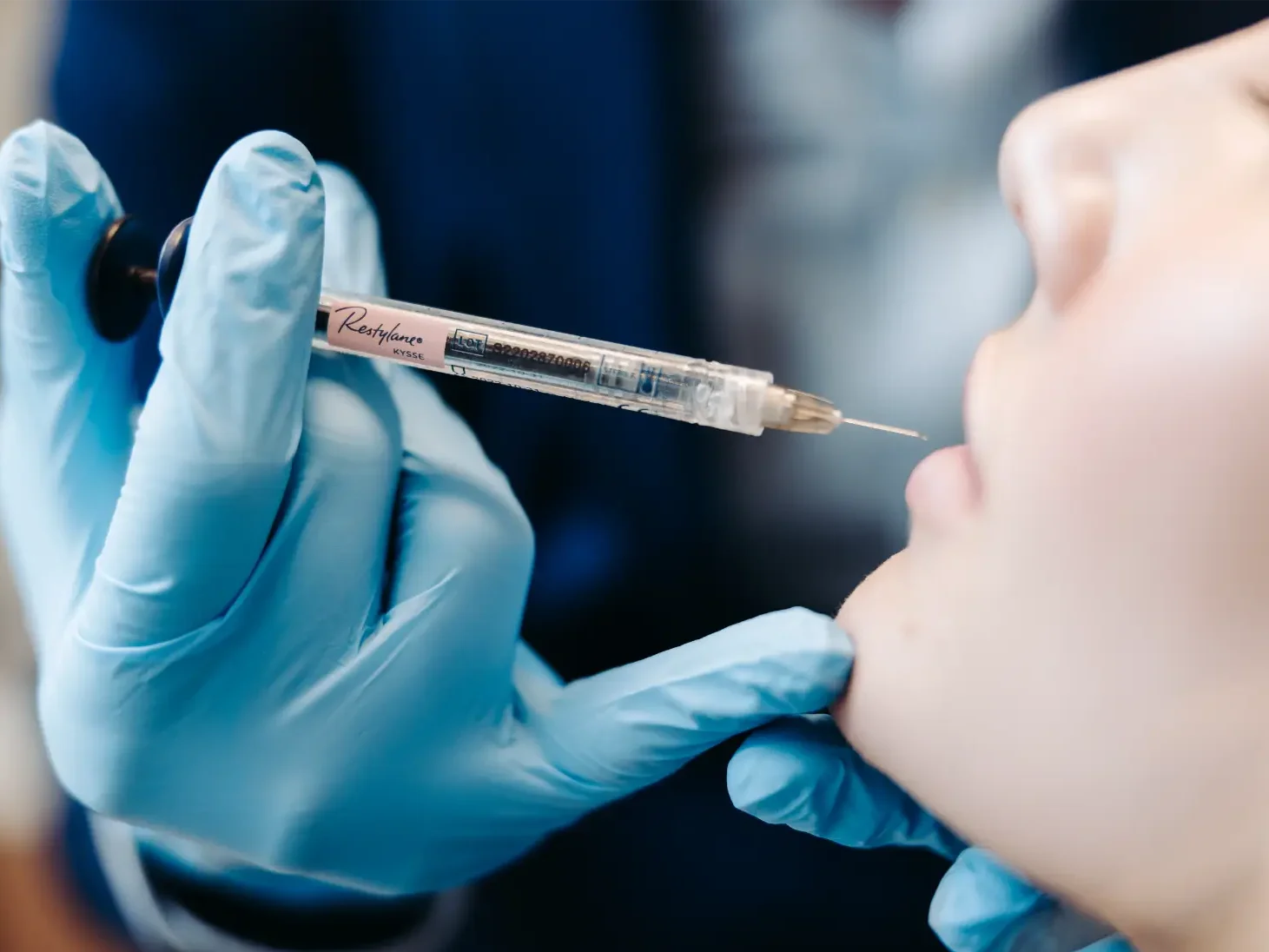
The two principal agents used in the gluteal region are calcium hydroxyapatite (CaHA), commercially available as Radiesse (Merz Aesthetics), and poly-L-lactic acid (PLLA), available as Sculptra (Galderma). Both are classified as true collagen biostimulators, though their mechanisms and timelines differ.
CaHA works via a dual mechanism: an immediate structural effect from the calcium microspheres, followed by a prolonged fibroblast activation that produces type I and III collagen over 3-6 months. When diluted to a hyperdiluted formulation, it spreads uniformly through tissue planes, making it well-suited to large surface areas such as the buttocks.
PLLA operates differently: it has no immediate volumising effect. Sculptra microspheres are gradually metabolised over months, triggering a sustained inflammatory-fibroblastic response that deposits new collagen.
A third option sometimes used in the gluteal region is hyaluronic acid (HA) volumisers such as UPmax (Ilikia/CGBio). UPmax is a high-viscosity HA filler designed for deep injection; it is not a collagen biostimulator and belongs to a different therapeutic class.
Who is — and is not — a candidate for this procedure
Patient selection is the single most important factor in achieving a satisfying outcome.
- Good candidates: patients with mild-to-moderate loss of gluteal firmness; surface skin laxity without significant ptosis; post-weight-loss patients with reduced skin elasticity.
- Absolute contraindications: active infection at the treatment site; autoimmune disease in active phase; pregnancy or breastfeeding; known hypersensitivity to product excipients; prior injection of non-resorbable materials (biopolymers, PMMA, silicone) in the buttocks.
Patients who want substantial volume augmentation should be counselled clearly: biostimulators are not a substitute for surgical fat grafting (BBL).
The treatment protocol: sessions, technique and what to expect
At INTI clinic, buttock biostimulator protocols are designed as a course of treatment. For hyperdiluted CaHA (Radiesse), clinical practice typically involves 2-3 sessions spaced 6-8 weeks apart. For PLLA (Sculptra), the protocol generally requires 3-4 sessions at 4-6 week intervals.
Published literature supports the safety and efficacy of hyperdiluted CaHA for body biostimulation, endorsed by the International Society of Aesthetic Plastic Surgery (ISAPS) and the American Society for Dermatologic Surgery (ASDS).
Patients travelling to Brasília from abroad will note that procedure costs at INTI are typically 40-60% lower than equivalent protocols in New York, London or Zurich, without any compromise in product quality. The clinic operates in English throughout for international patients.
Dr. Thiago Perfeito
CRM-DF 23199 · Aesthetic and Regenerative Medicine
Physician with more than 10 years of practice in aesthetic and regenerative medicine. Master's degree in Aesthetic Medicine (2024). International training at Harvard Medical School and Mayo Clinic. Member of ASLMS, A4M, AMS, and NYAS. Practicing in Brasília, Lago Sul.
Learn about Dr. Thiago →How to choose your buttock filler doctor
Who injects matters as much as the product, and five points about that choice can be verified in advance. Here is each one for Dr. Thiago Perfeito:
- Active medical license: CRM-DF 23199, searchable on the Brazilian Federal Council of Medicine (CFM) doctor search. Practice in Aesthetic and Regenerative Medicine.
- Verifiable training: Master's in Aesthetic Medicine (Esneca, Spain) and international training at Harvard Medical School and Mayo Clinic; the full background is on About Dr. Thiago.
- Buttock-specific experience: more than 500 buttock cases performed.
- Product identification: the boxes are shown to the patient and opened in front of her, and every lot label is stuck into her patient record.
- Complication follow-up: any complication, of any kind, is followed closely by Dr. Thiago in person.
Body hyaluronic acid or biostimulator? Body hyaluronic acid (UPmax, Sofiderm) adds volume and projection: R$ 18,000 to R$ 55,000 per cycle. A collagen biostimulator (Radiesse, Sculptra) treats firmness, laxity and skin quality without meaningful volume: R$ 2,900 to R$ 3,900 per box, at least 1 per side and ideally 2 to 4 per side. Side-by-side: glute augmentation options in Brasília.
Your goal decides the approach. Volume and a lifted, rounder profile call for body hyaluronic acid; laxity and cellulite, a biostimulator; many plans combine both. Hip dips (the lateral hip depressions) are corrected with body hyaluronic acid placed locally.
How much hyaluronic acid? In Dr. Thiago's practice, common amounts of body hyaluronic acid in the buttocks range from 30 mL to 90 mL in total: 30 mL total (15 mL per side) for subtle adjustments, 60 mL (30 mL per side) for moderate adjustments and 90 mL (45 mL per side) for larger projection. The volume for your case is set at the in-person consultation, and the price follows the per-cycle range above.
Lago Sul or Asa Sul? Dr. Thiago sees patients only in Lago Sul, at INTI Clinic (SHIS QI 11, Deck Brasil, Bl. O, Sala 115), about 15 to 20 minutes by car from Asa Sul and the Plano Piloto. There is no Asa Sul office. More in choosing a glute doctor in Brazil.
Frequently asked questions about Biostimulator buttocks
-
Does it replace BBL surgery?
No. Biostimulators and surgical Brazilian Butt Lift (fat grafting) address fundamentally different clinical problems. Biostimulators — CaHA and PLLA — improve skin quality, firmness and mild contour definition by stimulating the body's own collagen production. They do not transfer volume. Patients seeking significant gluteal augmentation require surgical fat grafting or implant placement. Biostimulators are best understood as a regenerative option for patients satisfied with their existing volume but seeking improved firmness and skin texture.
-
How many sessions?
The number of sessions depends on the agent and the patient's tissue response. Hyperdiluted calcium hydroxyapatite (CaHA/Radiesse) typically requires 2-3 sessions spaced 6-8 weeks apart. Poly-L-lactic acid (PLLA/Sculptra) generally requires 3-4 sessions at 4-6 week intervals. The precise course is determined at initial consultation, once skin quality, laxity and patient goals have been assessed.
-
How much does it cost in Brasília?
Biostimulator protocols at INTI clinic in Brasília are typically priced 40-60% below equivalent treatments in New York, London or Zurich. The products used — Radiesse (Merz Aesthetics) and Sculptra (Galderma) — are the same international brands available in premium clinics worldwide. A precise cost estimate is provided at consultation.
-
Is it safe?
Both CaHA (Radiesse) and PLLA (Sculptra) have well-established safety profiles documented in international peer-reviewed literature. Adverse effects are generally mild and transient — bruising, swelling and tenderness at injection sites, resolving within days. An absolute contraindication exists for patients who have previously received biopolymers, PMMA or liquid silicone in the buttocks.
-
How long do results last?
Results from CaHA (Radiesse) typically persist for 12-18 months. PLLA (Sculptra) produces collagen that may remain visible for up to 24 months post-treatment. Most patients at INTI plan follow-up sessions annually to maintain outcomes.
Schedule a consultation at INTI clinic, Brasília
Dr. Thiago Perfeito (CRM-DF 23199) conducts all consultations and procedures personally. The clinic operates in English for international patients. INTI is located in Lago Sul.